




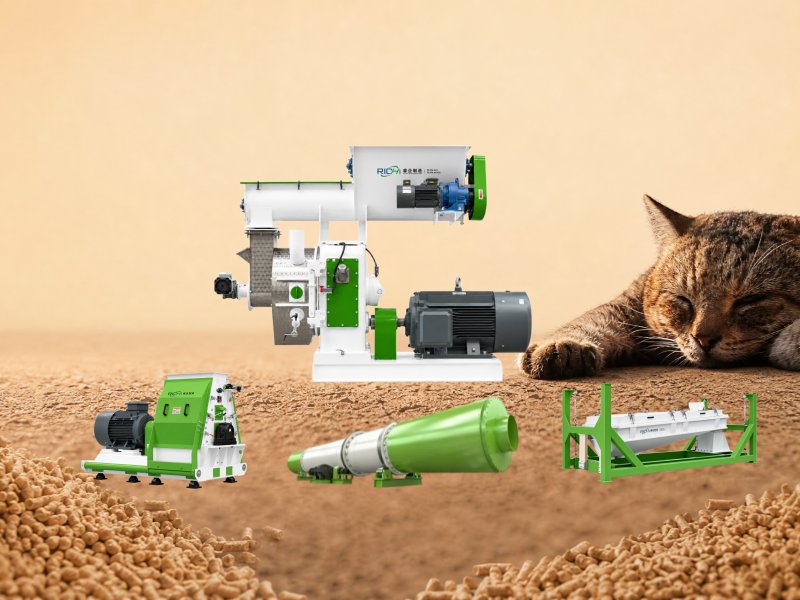
Starting a cat litter manufacturing business is not simply a matter of purchasing a pellet machine and finding some sawdust.
A commercial factory needs a material flow that can continuously transform irregular wood residues into a consistent packaged product.
This means thinking about the plant as a sequence of connected decisions.
Where does the raw material enter?
How large are the wood particles?
Does the material require drying?
How will it be stored?
How will additives be introduced?
How will finished pellets be cooled and screened?
And perhaps most importantly:
What does the customer expect from the final product?
These questions form the basis of a practical Sawdust Cat Litter Production Equipment plan.
Start With the Raw Material
The first step is identifying the available raw material.
Possible sources include:
- Sawmills
- Furniture factories
- Woodworking workshops
- Wood product manufacturers
- Timber processing companies
- Wood recycling operations
The source matters because different industries generate different types of residue.
A sawmill may provide chips and coarse particles.
A furniture factory may produce relatively fine sawdust.
A woodworking plant may generate mixed shavings.
The production line should be designed around the actual material rather than a theoretical raw-material specification.
Step One: Pre-Treatment
Large pieces may require initial size reduction.
If the factory receives logs, branches or large offcuts, a chipper may be needed before hammer milling.
If it receives wood chips, a hammer mill may be sufficient.
If it receives ready-to-use sawdust, the crushing stage may be minimized.
This creates a modular approach to factory design.
Not every plant needs every machine.
Step Two: Moisture Management
Once the material has an appropriate particle size, moisture becomes the next consideration.
A dryer may be required when incoming sawdust contains excessive moisture.
The dryer should be sized according to:
Material flow × moisture removal requirement × operating hours
Rather than simply choosing a machine because it has a large nominal capacity.
This calculation becomes particularly important for industrial projects.
Step Three: Temporary Storage
A buffer silo can create continuity between raw-material preparation and pelletizing.
Without sufficient buffer capacity, a short interruption in the crushing or drying section may immediately affect the pelletizing section.
Storage also allows the plant to separate different raw-material batches.
For a factory using several types of wood, this can make material management easier.
Step Four: Mixing and Formulation
Not every wood cat litter product has exactly the same formula.
Some products may rely heavily on wood fiber characteristics.
Others may use binders or functional additives.
If additives are required, accurate mixing becomes important.
A mixer should create a consistent distribution of the ingredients before the material enters the pelletizing section.
This is particularly important when the additive percentage is relatively small.
Step Five: Pelletizing
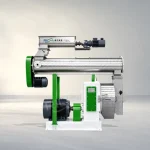
The pellet machine compresses the prepared material into the desired shape.
The die determines the basic pellet diameter.
The operating parameters influence pellet density and strength.
The raw material also plays a role.
This is why the pelletizer should not be selected independently of the upstream preparation system.
The machine needs to receive material within an appropriate operating range.
How Much Capacity Does a Factory Really Need?
Capacity planning should start with sales expectations.
Suppose a company estimates that it can sell 500 kg of finished litter per hour.
Installing a plant designed for several tons per hour may create unnecessary investment and underutilization.
On the other hand, a company with established distribution channels may need a production line capable of continuous expansion.
Capacity should therefore be connected to the business plan.
Typical questions include:
- How many working hours per day?
- How many production days per month?
- What packaging sizes?
- How much finished product can be sold?
- Will the plant produce one product or several?
- Is future expansion expected?
These questions are more useful than choosing capacity based solely on equipment catalogues.
What Happens After Pelletizing?
The pellets are not immediately ready for packaging.
They may need cooling.
They may also need screening.
Cooling reduces product temperature and prepares the pellets for handling.
Screening separates qualified product from fines and oversized particles.
The final product can then move to packaging.
This creates a basic downstream sequence:
Pelletizing → Cooling → Screening → Packaging
For some product concepts, additional processes such as fragrance application or dust management may be incorporated.
Why Dust Control Deserves Attention
Wood-based production naturally generates fine particles.
Crushing, conveying, screening and packaging can all contribute to dust.
A commercial plant should therefore consider dust collection as part of the factory design.
Dust control can improve the working environment and help maintain cleaner equipment areas.
It can also reduce material loss.
Rather than adding dust-control equipment at the end of the project, it is better to integrate it into the original plant layout.
How Does Packaging Influence Production?
Packaging is sometimes treated as the final step that can be added later.
However, packaging capacity can become a bottleneck.
If the pelletizing section produces 3 T/H but the packaging system can only handle a fraction of that output, finished product may accumulate.
The packaging system should therefore match the production capacity.
Packaging format also matters.
A factory producing 2 kg retail bags will require a different packaging workflow from one producing 15 kg professional bags.
Can One Plant Produce Different Products?
It can, depending on the design.
A wood-based cat litter manufacturer may eventually want to offer:
- Fine pellets
- Larger pellets
- Different wood species
- Scented products
- Unscented products
- Different packaging sizes
This creates a need for production flexibility.
A flexible pellet maker can be part of this strategy, but flexibility also depends on the mixer, storage system, screening and packaging equipment.
Why Layout Is More Than Machine Placement
A production-line layout should reduce unnecessary movement.
Raw material should have a logical path from receiving to finished-product storage.
Conveyors should be positioned to minimize sharp turns and excessive lifting.
Maintenance areas should remain accessible.
Operators should be able to monitor important equipment without crossing hazardous traffic zones.
The factory should also have enough room for future expansion.
A good layout is therefore part of production engineering, not simply a drawing exercise.
How Should a New Factory Handle Multiple Raw Materials?
A company may have access to both sawdust and wood chips.
Instead of forcing both materials through exactly the same preparation process, the plant can use separate pretreatment routes before combining them.
For example:
Wood chips → hammer mill → drying
Fine sawdust → drying
Both streams can then enter a common storage and pelletizing section.
This can make better use of locally available raw materials.
What About Existing Wood-Processing Companies?
For an existing wood-processing company, the project can be particularly interesting.
The company already has:
- Raw materials
- Storage
- Material-handling systems
- Production workers
- Industrial space
- Supplier relationships
The cat litter plant can potentially use part of this existing infrastructure.
However, consumer-product manufacturing introduces new requirements, especially in packaging, quality control and product consistency.
The company should therefore evaluate the transition carefully.
How Does Equipment Integration Affect Investment?
Buying individual machines from different suppliers can sometimes create compatibility challenges.
Motor specifications, conveyors, control systems and communication protocols may differ.
Integrated engineering can simplify these relationships.
A supplier such as Richi Machinery can be involved in configuring several sections around a common production target.
This does not eliminate the need for the buyer to verify technical specifications, but it can reduce the complexity of coordinating multiple equipment interfaces.
What Should Be Included in the Project Brief?
A useful project brief can be only one page.
It should include:
Raw material: sawdust, chips, shavings or mixed wood
Moisture: approximate range
Capacity: target T/H
Pellet size: required diameter
Additives: if any
Packaging: bag size and packaging type
Working schedule: hours per day
Factory space: available dimensions
Automation: desired level
With these details, equipment selection becomes much more practical.
Where Can Buyers Start Their Research?
Buyers often search for individual machines first.
A better approach is to search by process.
Instead of only searching for “cat litter pellet machine,” also investigate:
- Wood crushing
- Sawdust drying
- Pellet cooling
- Pellet screening
- Cat litter packaging
- Dust collection
- Material conveying
This helps reveal the hidden equipment required for a complete plant.
Those researching the overall process can from this source obtain additional background before preparing a factory layout or requesting technical proposals.
The Factory Is a System, Not a Machine
The biggest conceptual mistake in many industrial projects is focusing too heavily on one machine.
A pelletizer cannot compensate for poorly prepared raw material.
A dryer cannot solve an undersized grinding system.
A packaging machine cannot compensate for inconsistent pellet production.
The factory succeeds when each section supports the next.
That is the real meaning of production-line integration.
Final Thoughts
A commercial sawdust cat litter factory should be designed backward from the finished product.
First define what customers should receive.
Then determine the pellet characteristics.
Then define the formulation.
Then determine raw-material preparation.
Finally, select the equipment needed to create that process.
This approach can help manufacturers avoid unnecessary equipment and build a production system that is easier to operate and expand.
For companies with reliable access to wood residues, sawdust cat litter offers an interesting route from industrial by-product to consumer product—but the opportunity becomes practical only when raw materials, equipment, layout and market demand are considered together.