


Different fish species have different nutritional requirements, feeding behaviors, growth rates, and living environments. As a result, a single fish feed formula cannot always provide the best feeding performance for every species. When producing sinking fish feed, manufacturers need to consider not only the nutritional composition but also pellet size, density, hardness, water stability, sinking speed, and digestibility.
Sinking fish feed is widely used for species that naturally feed in the middle or lower parts of the water column or prefer feed that gradually sinks. Depending on the species, the feed may need to sink quickly, sink at a controlled rate, or remain stable underwater for a certain period.
Producing high-quality sinking fish food pellets therefore requires a combination of suitable ingredients, accurate formulation, proper raw material preparation, and controlled processing. The same production line can often manufacture different types of sinking feed by changing the formula, die, processing parameters, and post-pellet treatment.
This article explains how to make sinking fish feed for different species and how to adjust the production process according to their specific requirements.
Why Different Fish Species Need Different Feed
Fish species differ significantly in their natural feeding habits.
Some species mainly feed near the surface, while others feed in the middle or bottom of the water. Some fish are carnivorous and require high levels of protein and fat, while others are omnivorous or herbivorous and can use higher proportions of plant-based ingredients.
Age and growth stage also affect nutritional requirements.
Young fish usually need smaller pellets and highly digestible nutrients. Larger fish can consume larger pellets and may require different nutrient ratios.
Therefore, sinking feed should be designed around the target species rather than simply using one universal formula.
Important factors include:
- Fish species
- Fish size
- Growth stage
- Feeding behavior
- Water temperature
- Farming system
- Target growth rate
- Required pellet size
- Desired sinking speed
- Water stability
What Are Sinking Fish Food Pellets?
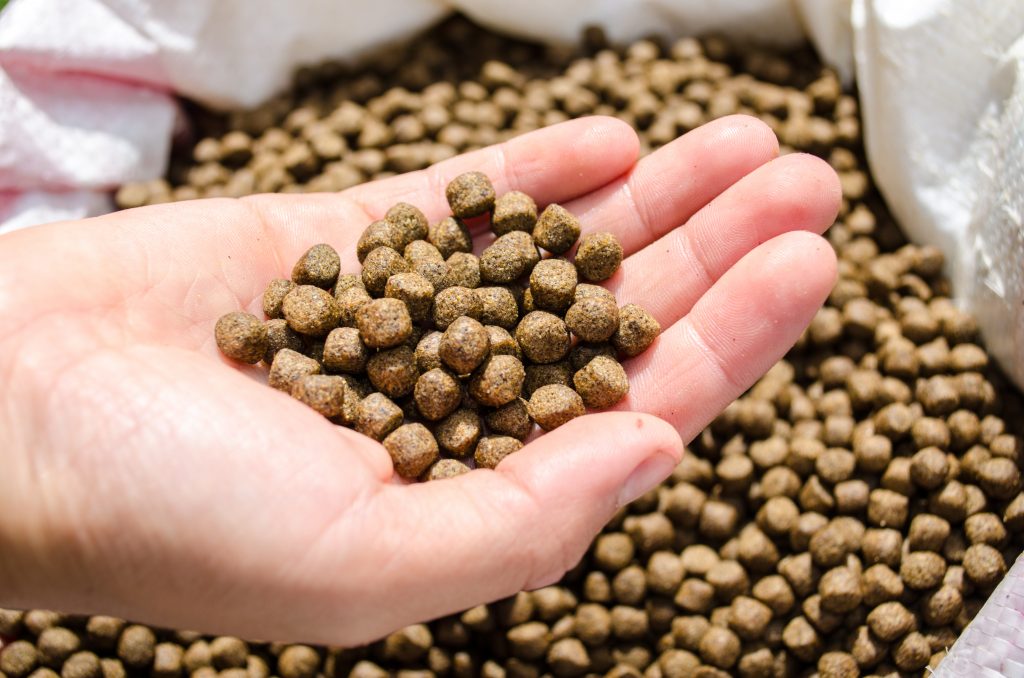
Sinking fish food pellets are compact feed particles designed to move downward through the water rather than remain floating on the surface.
Their sinking behavior is mainly related to pellet density and structure.
Compared with floating feed, sinking feed generally needs to have sufficient density to overcome buoyancy.
However, the objective is not necessarily to make the pellets as dense as possible.
If the pellets sink too quickly, fish may have less opportunity to consume them. If they sink too slowly, they may not reach the feeding zone required by the target species.
Therefore, the desired sinking speed should be determined according to the feeding behavior of the fish.
1. Understand the Target Fish Species
The first step is understanding the biological and feeding characteristics of the target fish.
Different species may require different combinations of:
- Protein
- Fat
- Carbohydrates
- Fiber
- Minerals
- Vitamins
- Amino acids
- Essential fatty acids
- Functional additives
The physical properties of the feed also need to be considered.
For example, bottom-feeding fish may require pellets that sink efficiently and remain stable on the bottom. Fish feeding in the middle water layer may require a different sinking rate.
Therefore, feed production should begin with species-specific requirements.
2. Making Sinking Feed for Carp
Carp are widely farmed in many parts of the world and are commonly raised in ponds and other freshwater systems.
Carp are generally omnivorous and can utilize a combination of plant and animal ingredients.
Typical ingredients may include:
- Soybean meal
- Corn
- Wheat
- Wheat bran
- Rice bran
- Fish meal
- Rapeseed meal
- Vegetable protein sources
- Fish oil or vegetable oil
- Vitamin and mineral premixes
The exact formula should be adjusted according to carp size, farming conditions, and nutritional objectives.
Carp feed pellets should have sufficient durability because the feed may remain in the water for some time before consumption.
The pellet size should also increase as fish grow.
For juvenile carp, smaller pellets are generally required. Larger carp can consume larger pellets.
3. Making Sinking Feed for Tilapia
Tilapia are commonly raised in freshwater and warm-water aquaculture systems.
They are omnivorous and can utilize plant-based protein sources efficiently.
Common ingredients may include soybean meal, corn, wheat, rice bran, fish meal, vegetable protein, vitamins, and minerals.
When producing sinking feed for tilapia, manufacturers should consider both nutrient density and pellet durability.
Although tilapia can consume different feed types, the required pellet size should correspond to the fish’s mouth size.
The formula can also change according to growth stage.
Juvenile tilapia may need higher nutrient density and smaller pellets, while larger fish can use larger sinking pellets.
4. Making Sinking Feed for Catfish
Catfish are commonly associated with bottom or lower-water feeding behavior, making sinking feed particularly relevant.
Catfish feed often requires relatively high protein levels, especially during early growth stages.
Possible ingredients include:
- Fish meal
- Soybean meal
- Corn gluten meal
- Poultry by-products
- Wheat
- Vegetable protein sources
- Fish oil
- Vitamins and minerals
The exact nutritional profile should be developed according to the catfish species and production stage.
Catfish pellets should sink reliably and maintain sufficient water stability.
If the pellets disintegrate too rapidly, nutrients may be released into the water before they are consumed.
Therefore, grinding, conditioning, pellet compression, drying, and cooling all need to be properly controlled.
5. Making Sinking Feed for Trout
Trout have different nutritional requirements from many warm-water omnivorous fish.
They generally require nutrient-dense feed with appropriate levels of high-quality protein and fat.
Ingredients may include fish meal, fish oil, soybean products, wheat, poultry by-products, and other protein and energy sources.
For trout, feed quality should be evaluated not only by pellet sinking performance but also by digestibility and nutrient utilization.
Pellet size should correspond to fish size.
Small trout require small feed particles, while larger trout can consume larger pellets.
The physical quality of the pellets should also be carefully controlled to minimize fines and prevent unnecessary nutrient loss in the water.
6. Making Sinking Feed for Salmon
Salmon feed is generally nutrient-dense and often contains significant levels of protein and lipid.
The formula may include marine ingredients, plant proteins, fish oil, vegetable oils, wheat, vitamins, minerals, amino acids, and functional additives.
When producing sinking salmon feed, manufacturers need to consider the physical properties of the pellets as well as nutritional density.
High-fat formulas can behave differently during pelletizing from lower-fat formulas.
The production process may therefore require careful control of grinding, mixing, conditioning, pelletizing, drying, and coating.
Oil may also be added after pelletizing through a coating system when required.
7. Making Sinking Feed for Shrimp
Although shrimp are not fish, sinking feed is extremely important in shrimp aquaculture.
Shrimp generally feed near the bottom, so sinking pellets are commonly used.
Shrimp feed often requires:
- Small pellet size
- High water stability
- Appropriate protein levels
- Good attractability
- Low fines
- Controlled sinking behavior
Water stability is particularly important because shrimp may take longer to consume feed.
If pellets break apart too quickly, nutrients can be lost into the water.
For small shrimp, fine grinding and precise pellet formation become especially important.
A superfine grinder can be incorporated into the production line when very small particle sizes are required.
(Related machine:https://pelletisingmachine.com/shrimp-feed-pellet-machine/)
8. Adjust Pellet Size According to Fish Size
Pellet diameter is one of the easiest characteristics to adjust between products.
A simple rule is that the pellet should be small enough for the target fish to consume comfortably but large enough to provide efficient feeding and handling.
Different growth stages may require different pellet sizes.
A commercial production line can use different dies to produce different pellet diameters.
For example, a manufacturer may produce small sinking pellets for juvenile fish and larger pellets for adult fish using the same basic production system.
However, changing pellet size may also require adjustments to drying, cooling, screening, and conveying conditions.
9. Control Pellet Density
Density is one of the most important factors in sinking feed production.
The pellet must have sufficient density to sink.
Density can be affected by:
- Raw material composition
- Grinding fineness
- Moisture
- Conditioning
- Compression ratio
- Pellet diameter
- Fat content
- Pellet structure
A higher-density pellet generally sinks more readily, but excessive density may not always be desirable.
The ideal density depends on the feeding behavior and feeding location of the target species.
Therefore, manufacturers should test the sinking performance of finished pellets rather than relying only on theoretical calculations.
10. Control Sinking Speed
Different fish may require different sinking rates.
Some bottom-feeding fish can consume rapidly sinking pellets. Other fish may benefit from feed that remains in the water column longer.
Sinking speed is influenced by pellet density, size, shape, surface structure, and water conditions.
Testing should therefore be conducted under representative conditions.
The same pellet may behave differently in water with different temperatures, salinity, depth, and movement.
11. Improve Water Stability
Water stability is particularly important for sinking feed.
Good sinking pellets should retain their physical structure long enough for fish to consume them.
Water stability is influenced by:
- Starch level
- Protein sources
- Grinding
- Conditioning
- Pellet compression
- Moisture
- Drying
- Cooling
- Binder selection
Proper conditioning can improve the binding characteristics of the material.
However, water stability should be balanced with digestibility. Extremely hard pellets are not automatically better pellets.
The goal is to create feed that remains physically stable while still being suitable for digestion.
12. Use Appropriate Raw Materials
Raw material selection should reflect both nutritional and processing requirements.
Protein ingredients provide amino acids and support growth.
Energy ingredients provide carbohydrates and other sources of energy.
Oils provide concentrated energy and essential fatty acids.
Vitamins and minerals support physiological functions.
Binders may be used to improve pellet integrity when necessary.
Attractants can also be included in some aquatic feed formulas to improve feed acceptance.
The final ingredient combination should be determined by the target species, growth stage, feed cost, local ingredient availability, and nutritional requirements.
13. Grind Ingredients Properly
Grinding is an important preparation step.
Coarse particles can make it more difficult to produce smooth and durable pellets.
Proper grinding improves particle uniformity and helps ingredients mix more evenly.
For small fish feed, a finer particle size may be necessary.
Hammer mills are commonly used for conventional grinding, while superfine grinding systems can be used for formulas requiring very fine particles.
The objective is to achieve the required particle size without unnecessarily increasing energy consumption.
14. Mix Ingredients Uniformly
After grinding and batching, ingredients need to be mixed.
A good mixer should distribute major ingredients and micro-ingredients evenly.
Uniform mixing helps ensure that each pellet has a similar nutritional composition.
This is especially important when the formula contains small quantities of vitamins, minerals, amino acids, attractants, or other additives.
An automatic batching and mixing system can improve production consistency in commercial feed plants.
15. Optimize Steam Conditioning
Steam conditioning prepares the material for pelletizing.
Steam adds heat and moisture and can improve the physical properties of the feed material.
Proper conditioning may result in:
- Better pellet formation
- Higher pellet durability
- Improved throughput
- Reduced pellet mill load
- Better starch gelatinization
The correct conditioning parameters vary with the formula.
High-fat formulas, high-protein formulas, and high-fiber formulas may require different processing conditions.
Therefore, the conditioner should be operated according to actual production requirements.
16. Pelletize the Feed
The pellet mill compresses conditioned material through die holes to form pellets.
Important pelletizing parameters include:
- Die hole diameter
- Die compression ratio
- Roller clearance
- Feed rate
- Material moisture
- Conditioning temperature
- Formula composition
The pellet mill should be properly matched to the complete production line.
A pellet mill that is too large or too small for the rest of the process can create bottlenecks.
This is why sinking fish feed production should be considered as a complete system rather than focusing only on the pelletizer.
17. Dry the Pellets Carefully
Fresh pellets usually contain more moisture than the desired final product.
Drying reduces moisture and improves storage stability.
The dryer should provide uniform treatment without overheating or excessively drying the pellets.
Drying conditions depend on:
- Pellet diameter
- Formula
- Initial moisture
- Production capacity
- Final moisture target
A properly selected dryer helps maintain consistent product quality.
18. Cool and Screen the Pellets
After drying, pellets should be cooled before final screening and packaging.
Cooling reduces temperature and helps stabilize moisture.
A screening machine then separates fines, broken pellets, and oversized particles.
Good screening improves product consistency.
Fines can sometimes be returned to the production process depending on the plant design and formula.
19. Add Oil and Functional Ingredients After Pelletizing
Some formulas benefit from post-pellet coating.
A coating machine can apply:
- Fish oil
- Vegetable oil
- Attractants
- Enzymes
- Other functional additives
Post-pellet coating can be useful for heat-sensitive ingredients or formulas requiring additional surface oil.
The coating system should distribute liquids uniformly to avoid excessive surface oil or uneven feed quality.
20. Use a Complete Production System
Producing different sinking feeds for different species requires flexible processing equipment.
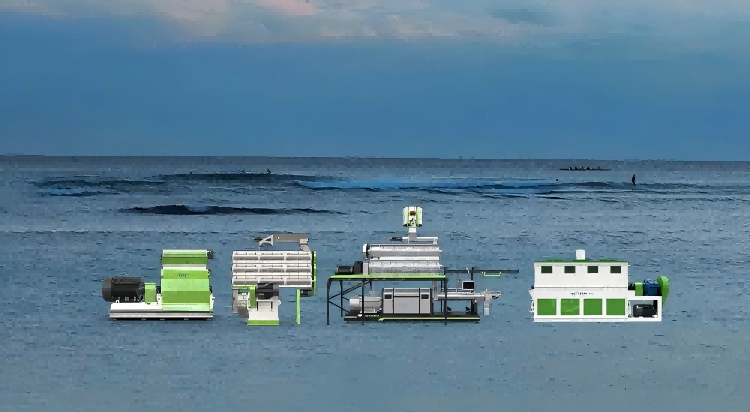
A complete sinking fish feed production system may include:
- Raw material cleaning equipment
- Hammer mill
- Superfine grinder
- Automatic batching system
- Feed mixer
- Steam conditioner
- Fish feed pellet mill
- Dryer
- Cooler
- Vibrating screen
- Coating machine
- Conveyors
- Bucket elevators
- Packing machine
- Dust collection system
- Electrical control system
The equipment configuration should be designed around the required capacity and product specifications.
For example, a factory producing small-diameter shrimp and juvenile fish feed may require finer grinding and more precise screening than a factory producing larger pellets for adult fish.
How to Make One Production Line Serve Different Species
A properly designed fish feed production line can often manufacture multiple feed products.
The manufacturer may change:
- Formula
- Pellet diameter
- Die compression ratio
- Knife position
- Conditioning parameters
- Drying conditions
- Coating formula
This flexibility allows one production line to serve different customer groups or different growth stages.
However, the production sequence should be planned carefully.
Producing high-fat or strongly colored feed before another formula may require cleaning procedures to prevent cross-contamination.
Formula management and production scheduling are therefore important parts of multi-species feed production.
Common Problems When Making Sinking Fish Feed
Pellets Float Instead of Sink
This may be caused by insufficient density, excessive air inclusion, inappropriate formula composition, or insufficient compression.
Pellets Sink Too Fast
Excessive density may cause the feed to reach the bottom before fish can consume it efficiently.
Pellets Disintegrate Quickly
Possible causes include poor conditioning, insufficient binding, improper formulation, inadequate compression, or excessive moisture.
Too Many Fines
Poor grinding, insufficient conditioning, incorrect die selection, worn equipment, improper cooling, or excessive conveying impact can all contribute to fines.
Pellets Have Uneven Sizes
Possible causes include unstable feeding, worn dies, incorrect knife adjustment, or inconsistent material preparation.
How RICHI Can Support Multi-Species Sinking Feed Production
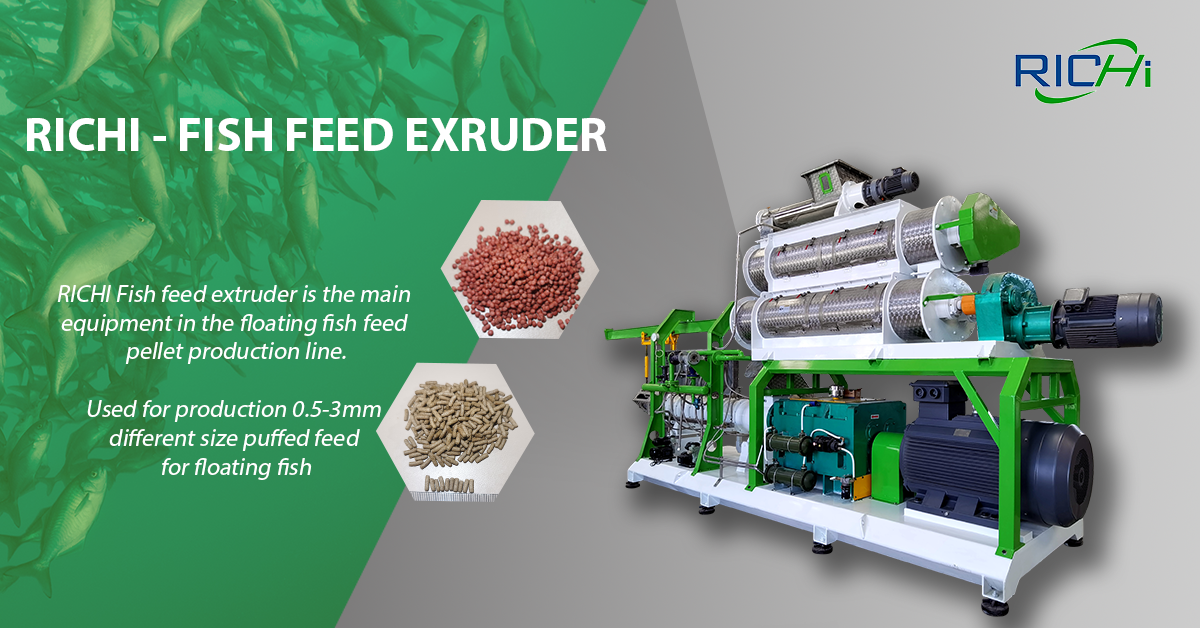
RICHI Machinery provides complete fish feed processing solutions for different aquatic feed applications.
Instead of supplying only a pelletizing machine, RICHI can integrate the major processing stages into a complete production line.
The equipment configuration can be designed according to:
- Target fish species
- Raw materials
- Formula
- Pellet size
- Required sinking characteristics
- Production capacity
- Automation level
- Factory layout
For example, a project producing several sizes of sinking feed may require interchangeable dies and flexible process control. A project producing small aquatic feed may require fine grinding and accurate screening. A large commercial plant may require automatic batching, centralized control, automatic packing, and high-capacity material handling.
The objective is to create a production system that can maintain stable processing conditions while allowing manufacturers to produce different feed specifications.
Frequently Asked Questions
Can the same machine make sinking feed for different fish species?
A complete production line can often manufacture feed for different species, but the formula and processing parameters may need to be changed. Different pellet sizes may also require different dies.
What ingredients are commonly used in sinking fish feed?
Common ingredients include fish meal, soybean meal, wheat, corn, rice bran, wheat bran, vegetable proteins, fish oil, vegetable oil, vitamins, minerals, amino acids, and functional additives.
How do I make sinking fish food pellets?
The general process includes raw material cleaning, grinding, batching, mixing, conditioning, pelletizing, drying, cooling, screening, optional coating, and packaging.
How do I make fish feed sink faster?
Increasing pellet density can generally increase sinking speed, but density should be controlled according to the feeding behavior of the target species. Formula, grinding, moisture, conditioning, and compression all affect density.
How can I improve water stability?
Proper formula selection, fine grinding, conditioning, suitable compression, controlled moisture, and proper drying can improve pellet water stability.
What pellet size should be used?
Pellet size should correspond to fish size and feeding behavior. Juvenile fish normally require smaller particles, while larger fish can consume larger pellets.
Can sinking feed be made with a pellet mill?
Yes. A pellet mill can form sinking pellets, but commercial production normally requires additional equipment for grinding, mixing, conditioning, drying, cooling, screening, conveying, and packing.
Conclusion
Making sinking fish feed for different species requires more than changing the ingredients in a formula. Each species may have different nutritional requirements, pellet sizes, density requirements, sinking speeds, water stability requirements, and feeding behaviors.
A successful production process therefore combines species-specific formulation with careful control of grinding, batching, mixing, conditioning, pelletizing, drying, cooling, screening, and coating.
High-quality sinking fish food pellets should have consistent size, appropriate density, good durability, suitable water stability, and a sinking behavior that matches the target species.
A flexible production line can make different types of sinking feed by adjusting formulas, dies, processing parameters, and coating systems. With the right equipment configuration and process control, manufacturers can produce feed for different fish species and growth stages while maintaining stable production and consistent product quality.